
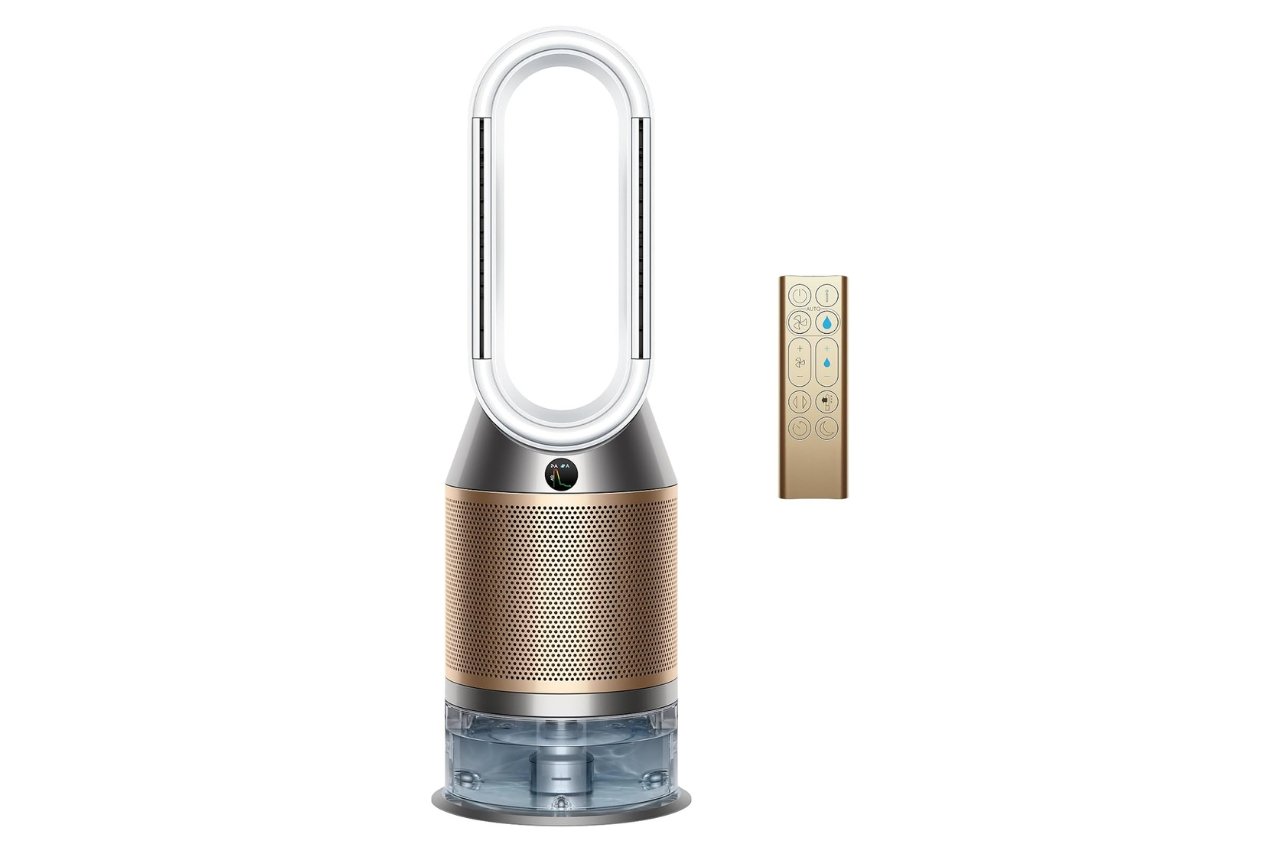
If you live near a busy road, your indoor air is likely worse than you think. The Dyson Purifier Cool PC2 DE NOx targets the specific pollutants urban homes face daily.
This 2-in-1 purifier and fan combines a K-Carbon filter that adsorbs up to 50% more Nitrogen Dioxide ($NO_2$) than standard activated carbon, a Selective Catalytic Oxidation (SCO) filter that continuously destroys formaldehyde at a molecular level, and a fully sealed HEPA H13 filtration system capturing 99.95% of ultrafine particles as small as 0.1 microns. For households exposed to heavy traffic emissions or gas-cooking byproducts, the PC2 DE NOx is the most pollution-specific Dyson purifier you can buy right now.
In this review, you’ll get a detailed breakdown of the PC2 DE NOx’s real-world purification performance, cooling ability, noise output, and whether it justifies its premium price tag over alternatives like the older Dyson TP09 Formaldehyde or competitors from Blueair and Coway.
Key Takeaways
- The Dyson Purifier Cool PC2 DE NOx features a K-Carbon filter that adsorbs 50% more nitrogen dioxide than standard activated carbon, making it ideal for homes near busy roads or with gas stoves.
- This 2-in-1 purifier and fan combines three filtration layers—K-Carbon for NOx, SCO for formaldehyde destruction, and HEPA H13 capturing 99.95% of ultrafine particles—delivering three-layer molecular defense against urban air pollution.
- The solid-state formaldehyde sensor provides accurate, dedicated readings without recalibration or cross-reactivity, displayed alongside real-time PM2.5, PM10, VOC, and NO₂ data in the MyDyson app.
- At premium pricing ($549–$649), the PC2 DE NOx is most suitable for traffic-adjacent homes, gas-cooking households, and families with asthma or allergies who need both particulate and gas-phase filtration.
- Operating quietly at lower speeds (ideal for sleep mode) with 350-degree oscillation, this purifier effectively handles rooms up to 800 square feet, though larger spaces may require a second unit.
- K-Carbon filter replacements cost approximately $70–$80 annually, and no current competitor matches the PC2 DE NOx’s combination of targeted NO₂ adsorption and catalytic formaldehyde destruction.
What Makes the Dyson PC2 De NOx Different
The “DE NOx” designation isn’t marketing fluff, it signals a meaningful upgrade in gas-phase filtration. Previous Dyson models like the TP07 or HP09 “Cryptomic” units focused primarily on formaldehyde destruction using a manganese dioxide catalytic filter. The PC2 DE NOx retains that SCO technology but adds a potassium carbonate-impregnated K-Carbon filter specifically engineered to trap $NO_2$, a toxic gas that seeps indoors from vehicle exhaust and gas stoves.
Dyson claims this K-Carbon filter adsorbs 50% more $NO_2$ than standard activated carbon filters. That’s a significant differentiator for anyone living within 200 meters of a major road, where $NO_2$ concentrations can be two to three times higher than urban background levels.
The solid-state formaldehyde sensor is another key distinction. Unlike cheaper gel-based sensors that degrade over time and cross-react with other VOCs, the electrochemical sensor in the PC2 DE NOx provides a dedicated, accurate formaldehyde reading that doesn’t need recalibration. The Dyson MyDyson app displays this data in real-time alongside $PM2.5$, $PM10$, VOC, and $NO_2$ readings.
So how does it compare to the PH04 or PH2 Humidify+Cool models? The PC2 is a purifier-fan only, no humidification. If you need humidification, you’ll want the PH2 DE NOx variant instead. But if your primary concern is gas-phase pollution rather than dry air, the PC2 DE NOx delivers sharper filtration focus at a slightly lower price point.
Design, Build Quality, and First Impressions
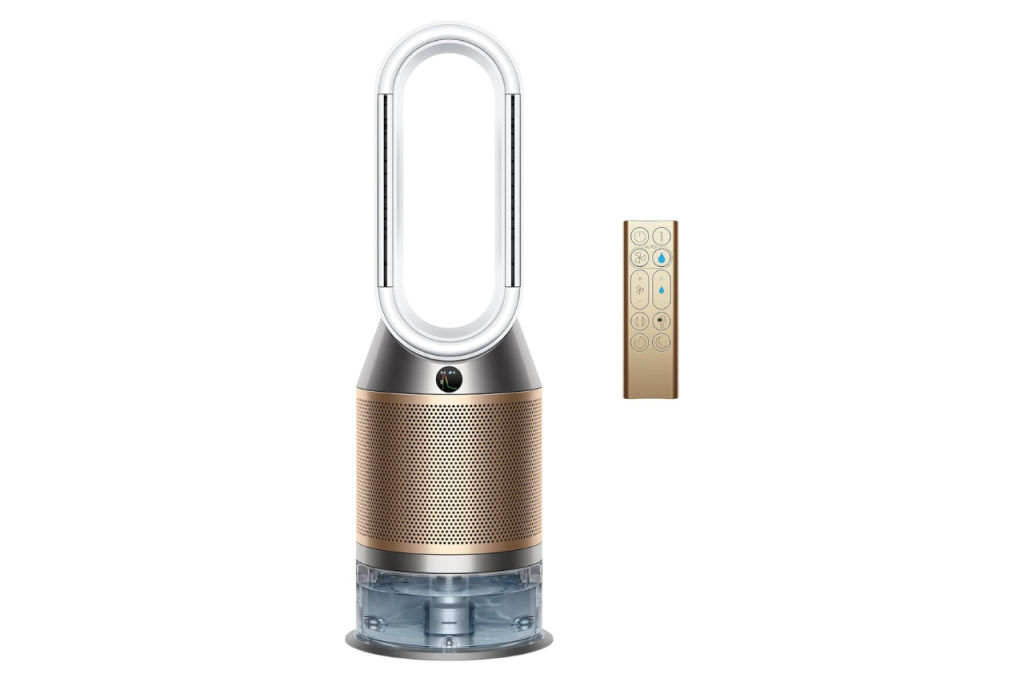
The PC2 DE NOx follows Dyson’s familiar bladeless tower design. It stands roughly 41 inches tall and weighs about 11 pounds, making it easy to reposition between rooms. The build quality feels premium, dense ABS plastic with a matte nickel-copper finish that resists fingerprints better than the glossy white models.
You get 350-degree oscillation via Dyson’s Air Multiplier technology, which projects purified air across an entire open-plan living area without exposed blades. The remote is small, magnetized, and snaps onto the top of the unit. Setup takes about five minutes: slide in the HEPA H13 and K-Carbon filters from the base, connect to your Wi-Fi through the MyDyson app, and you’re running.
“I moved from a TP07 to the PC2 DE NOx and the formaldehyde sensor alone is a game changer. My old unit couldn’t distinguish HCHO from cooking VOCs. This one gives me a separate, stable reading.” via r/dyson
The LCD screen on the front cycles through air quality metrics clearly, though in a dark bedroom you may want to dim it via the app. Overall, the industrial design hasn’t changed radically from previous generations, but the internal filtration architecture is where the real upgrades live.
Air Purification Performance and NOx Removal
This is where the PC2 DE NOx earns its keep. The fully sealed HEPA H13 filtration system ensures that what gets captured stays captured, no dirty air bypasses around filter edges. Combined with the K-Carbon filter’s $NO_2$ adsorption and the SCO filter’s continuous formaldehyde destruction, you’re looking at three-layer molecular defense.
In practical terms, if you’re cooking on a gas range, the unit detects the $NO_2$ spike within seconds and ramps up automatically in Auto mode. The Selective Catalytic Oxidation filter converts formaldehyde ($HCHO$) into water and $CO_2$ at room temperature, and because it’s catalytic, it doesn’t saturate like a traditional carbon filter, it regenerates continuously.
The K-Carbon filter does have a finite lifespan. Dyson recommends replacement every 12 months depending on usage and pollution levels. Replacement filters cost approximately $70–$80, which is competitive with Blueair and Coway filter costs. You can track filter life percentage directly in the MyDyson app.
“We live 50 feet from a four-lane road. The NO2 readings on the app drop from ‘severe’ to ‘good’ within about 20 minutes of turning it on in our 250 sq ft bedroom.” via r/AirPurifiers
For rooms up to approximately 800 square feet, the PC2 DE NOx circulates and filters air effectively. Larger open-concept spaces may need a second unit or supplemental purifier.
Here’s a quick comparison against previous Dyson models:
| Feature | PC2 DE NOx (2025) | TP09 Formaldehyde | TP07 Cryptomic |
|---|---|---|---|
| K-Carbon $NO_2$ Filter | ✅ Yes | ❌ No | ❌ No |
| SCO Formaldehyde Destruction | ✅ Yes | ✅ Yes | ✅ Yes |
| Solid-State HCHO Sensor | ✅ Yes | ✅ Yes | ❌ No |
| HEPA H13 Fully Sealed | ✅ Yes | ✅ Yes | ✅ Yes |
| 350° Oscillation | ✅ Yes | ✅ Yes | ✅ Yes |
| Humidification | ❌ No | ❌ No | ❌ No |
Cooling Capability and Noise Levels
Let’s be clear: this is not an air conditioner. The PC2 DE NOx moves purified air using Dyson’s Air Multiplier technology, creating a cooling breeze effect. On a hot day, it won’t drop your room temperature, but the directed airflow feels pleasant up to about 8–10 feet away on higher settings.
Dyson offers 10 speed settings. At speed 1–3, the unit is near-silent, ideal for sleep mode. At maximum speed (10), it generates noticeable fan noise, roughly comparable to a conversation-level 50–55 dB. Night mode automatically dims the display and limits airflow to quieter speeds.
For bedrooms, the Dyson PC2 DE NOx noise levels on sleep mode are genuinely unobtrusive. Several users on forums report sleeping comfortably at speed 2–4. But if you need aggressive purification overnight (say, after painting a room), running at speed 7+ will be audible.
Pro & Cons
Here’s a straightforward breakdown based on real-world usage:
Pros:
- K-Carbon filter captures 50% more $NO_2$ than standard carbon, ideal for traffic-adjacent homes
- SCO catalytic filter destroys formaldehyde permanently without saturating
- Solid-state formaldehyde sensor provides accurate, dedicated $HCHO$ readings
- Fully sealed HEPA H13 captures 99.95% of particles down to 0.1 microns
- 350-degree oscillation distributes purified air across entire rooms
- MyDyson app provides granular, real-time air quality data
- Quiet operation at lower speeds: effective night/sleep mode
Cons:
- No humidification (you’d need the PH2 DE NOx variant for that)
- Fan cooling only: does not lower room temperature
- Large footprint may feel oversized in small apartments
Who Should Buy the Dyson Purifier Cool PC2 De NOx
You should seriously consider the PC2 DE NOx if your home sits near a highway, busy intersection, or industrial area where $NO_2$ levels stay elevated. It’s also a strong pick if you cook regularly on a gas range, since combustion byproducts include both $NO_2$ and formaldehyde.
Families with young children or members who suffer from asthma or allergies will benefit from the HEPA H13 fully sealed filtration system combined with the gas-phase filters. The dual-sensor setup (particulate + formaldehyde) gives you data you can actually act on, rather than a single generic “air quality” number.
If you also need humidification, say, you live in a dry climate or suffer from winter congestion, look at the Dyson PH2 DE NOx Humidify+Cool instead. It adds UV-C hygienic humidification that kills 99.9% of waterborne bacteria before misting.
For a more budget-friendly standalone HEPA purifier to supplement in a second room, the Levoit Core 400S is a solid option at under $200, though it lacks the $NO_2$-specific filtration.

Data Insights and Analysis
According to a 2025 report from the European Environment Agency, $NO_2$ exposure remains the second-largest air quality health risk in urban Europe, contributing to an estimated 49,000 premature deaths annually. Indoor $NO_2$ concentrations in homes with gas stoves can reach 200–400 ppb during cooking, well above the WHO guideline of 25 µg/m³ annual mean.
Expert Note: "The reason potassium carbonate works better than standard activated carbon for $NO_2$ is selectivity. Plain carbon adsorbs a broad range of VOCs but has weak affinity for acidic gases like $NO_2$. The K-Carbon impregnation creates an alkaline surface that chemically reacts with $NO_2$, converting it into potassium nitrate, a stable, non-toxic salt trapped in the filter matrix. This is why Dyson can claim 50% greater adsorption: it's a chemisorption process, not just physical trapping."

Dyson Purifier Humidify+Cool PH2 De-NOx
Dyson PC2 De NOx Alternatives
If the PC2 DE NOx’s price gives you pause, here are credible alternatives:
The Blueair Blue 3210 offers excellent HEPA filtration at around $150, but it has no gas-phase filtration whatsoever, no carbon, no $NO_2$ removal, no formaldehyde destruction. For particulate-only concerns, it’s great. For gas pollution, it falls short.

The Coway Airmega 250 sits in the $300–$350 range and includes an activated carbon filter for VOCs. But, it uses standard activated carbon without potassium carbonate impregnation, so its $NO_2$ capture efficiency is significantly lower than the PC2 DE NOx.
The IQAir HealthPro Plus is a medical-grade option at $900+ that excels at particle filtration with its HyperHEPA technology. But again, it doesn’t specifically target $NO_2$ with a dedicated chemistry-based approach.

Eventually, no competitor currently matches Dyson’s combination of K-Carbon $NO_2$ adsorption plus catalytic formaldehyde destruction in a single consumer unit. If traffic pollution and gas-cooking emissions are your primary concerns, the PC2 DE NOx remains the most targeted solution available in 2026.
Frequently Asked Questions
What makes the Dyson PC2 DE NOx different from other air purifiers?
The Dyson PC2 DE NOx features a K-Carbon filter that adsorbs 50% more NO2 than standard activated carbon, an SCO catalytic filter that continuously destroys formaldehyde, and a solid-state formaldehyde sensor for accurate readings. This combination targets traffic emissions and gas-cooking byproducts more effectively than competitors.
How much does the Dyson Purifier Cool PC2 DE NOx cost?
The Dyson PC2 DE NOx typically costs between $549 and $649 depending on retailer. Additional annual costs include K-Carbon filter replacements at approximately $70–$80 per year, making it a premium investment for pollution-specific air purification.
Can the Dyson PC2 DE NOx remove nitrogen dioxide (NO2)?
Yes. The K-Carbon filter specifically targets NO2 from vehicle exhaust and gas stoves, adsorbing 50% more NO2 than standard activated carbon. Users near major roads report NO2 levels dropping from ‘severe’ to ‘good’ within 20 minutes of activation.
How often do you need to replace Dyson PC2 DE NOx filters?
Dyson recommends replacing the K-Carbon filter every 12 months depending on usage and local pollution levels. You can track filter life percentage directly in the MyDyson app to know when replacement is needed.
Is the Dyson PC2 DE NOx a good option for allergy sufferers?
Yes. The fully sealed HEPA H13 filtration system captures 99.95% of ultrafine particles as small as 0.1 microns, combined with gas-phase filters that remove formaldehyde and NO2. This makes it ideal for families with allergies, asthma, or young children.
What is the difference between the Dyson PC2 DE NOx and the Dyson PH2 DE NOx?
The PC2 DE NOx is a purifier-fan only without humidification. The PH2 DE NOx variant adds UV-C hygienic humidification that kills 99.9% of waterborne bacteria. Choose the PH2 if you need both purification and humidification in a dry climate.
Sources:
- Dyson Official – Purifier Cool DE NOx Product Page
- Reddit r/dyson Community
- Reddit r/AirPurifiers Community
- European Environment Agency – Air Quality in Europe 2024 Report
- WHO Global Air Quality Guidelines

Susan is a professional writer. She has been a writer for eight years and has always been so fulfilled with her work! She desires to share helpful, reliable, and unbiased information and tips about tech and gadgets. She hopes to offer informative content that can answer users’ questions and help them fix their problems.